


A conventional solar inverter does one job: it converts the DC from your panels into AC for the grid. A hybrid inverter does that and also manages a battery, a grid connection, and, in many designs, a backup generator, all from one cabinet. For a small factory, a cold-storage unit, a farm or a commercial building, this decides whether the solar array keeps working during an outage or shuts down with the grid.
In Short
- A hybrid inverter combines PV conversion, battery charging and discharging, and grid or generator management in one unit.
- Three numbers drive most sizing decisions: PV input power versus AC rating, the MPPT voltage window, and the battery voltage and current limits.
- The HB3299EH800~HB3635EH800 series is a three-phase, 800V-class battery design with a 2:1 PV-to-AC ratio, IP66 outdoor protection and up to 15 units in parallel.
- Efficiency figures are best-case laboratory values. Derating, battery choice and system layout matter as much as the headline percentage.
What a Hybrid Inverter Actually Does
Think of the unit as a traffic controller for three energy sources and one load:
- PV to load: solar power feeds the site directly during the day, which is the most efficient path because it avoids battery conversion losses.
- PV to battery: surplus power charges the battery for evening use or for outages.
- Battery to load: when PV is low or the grid is down, the battery supplies the site.
- Grid or generator to load or battery: the grid, or a generator connected to the dedicated port, fills any gap and can charge the battery.
The difference from a plain grid-tie inverter shows up during a blackout. A grid-tie inverter must shut down when the grid fails (this is called anti-islanding protection). A hybrid inverter isolates from the grid and keeps supplying the loads from PV and battery. The HB3299EH800 series lists a typical transfer time of under 10 ms, which is fast enough that many loads ride through the switch without noticing, though you should still check with any equipment that is highly sensitive to interruption.
Hybrid vs. String vs. Off-Grid: Which One Fits?
| Feature | Grid-tie (string) inverter | Hybrid inverter | Off-grid inverter |
|---|---|---|---|
| Works during a grid outage | No | Yes | Yes |
| Battery support | Not built in | Built in | Built in |
| Exports to grid | Yes | Yes | No |
| Time-of-use tariff shifting | No | Yes (needs scheduling features) | Not applicable |
| Generator integration | No | Often, model-dependent | Often |
| Typical best use | Stable grid, no backup needed | Outage resilience, peak-tariff savings, weak grids | No grid available |
General categories; individual products vary. Always confirm features against the specific datasheet.
The Five Parameters That Matter Most
1. PV input power versus AC rating (the DC/AC ratio)
Panels rarely deliver their nameplate power. Heat, dust, angle and haze usually keep real output well below the rated peak. Designers therefore install more DC capacity than the inverter's AC rating, accepting small clipping losses at midday in exchange for better use of the inverter through the rest of the day.
On the SUNOHOO series, the maximum PV input is exactly twice the rated grid-connected power in every model. The HB3299EH800 takes up to 60 kW of PV against a 29.9 kW rated output, and the HB3635EH800 takes 127 kW against 63.5 kW. The manufacturer states that PV power can reach up to twice the rated power while still supporting full-power grid connection alongside battery charging. This is useful in practice because it lets the array charge a battery and export at the same time, rather than forcing a choice between the two.
2. MPPT voltage window and string design
Maximum power point tracking (MPPT) keeps each string of panels at the voltage that yields the most power. Two limits matter when you lay out strings:
- Upper limit: the string's open-circuit voltage on the coldest expected morning must stay below the inverter's maximum input (1000 Vdc on this series). Panel voltage rises as temperature falls, so a string that is fine in summer can exceed the limit in winter. Use the temperature coefficient on your panel datasheet to calculate it.
- Lower limit: the string must stay above the startup voltage (180 Vdc) and ideally inside the full-load window on hot afternoons, when panel voltage sags.
The datasheet gives a general MPPT range of 150~850 Vdc, but the full-load window varies by model: 250~850 Vdc for the HB3299EH800, 360~850 Vdc for the HB3360EH800, and 420~850 Vdc for the HB3408EH800 and HB3510EH800. A higher-rated model needs a higher string voltage to deliver full power, so longer strings suit the bigger units. Check this value early in design; it is a common source of avoidable underperformance.
3. Battery voltage range and charge profile
This series is a high-voltage battery design, accepting 150~800 V on the battery side with maximum charge and discharge current listed as 70A+70A. Higher voltage means lower current for the same power, which reduces cable losses and conductor size. The datasheet lists compatibility with lead-acid, lithium and gel batteries, and offers three-stage, equalization and self-adaptive BMS charging modes. The manufacturer also notes that three-stage charge-discharge conversion produces low current ripple, which it says helps extend battery life.
One practical caution: "compatible with lithium" is not the same as "pre-validated with your specific battery." Before purchase, confirm communication protocol support (the series lists RS485, CAN and DRM as standard) with your battery supplier. If you are choosing batteries separately, see SUNOHOO's energy storage battery range.
4. Grid-side quality: power factor and distortion
For a commercial site, the utility's interconnection rules often matter as much as the inverter's headline power. The listed values here are a power factor above 0.99 at rated power (adjustable from 0.8 leading to 0.8 lagging), current distortion (THDi) below 3%, and voltage distortion (THDu) below 2% on linear loads. An adjustable power factor lets the inverter support reactive power requirements where a utility asks for it.
5. Environmental and protection ratings
An IP66 rating means the enclosure is dust-tight and withstands powerful water jets, so outdoor wall mounting is realistic. Look just as closely at derating. This series is rated for -40°C to 60°C but derates above 45°C, and above 3,000 m altitude (it is rated to 4,000 m). If the inverter will sit on a sun-baked west wall in a hot climate, plan shade and airflow, because the derating threshold is lower than the maximum temperature.
Case Study: The SUNOHOO HB3299EH800~HB3635EH800 Series
This three-phase series targets small industrial and commercial sites. The figures below come from the manufacturer's published datasheet. Specifications are subject to change without notice, so confirm the current values on the product page or the product specification PDF before finalizing a design.
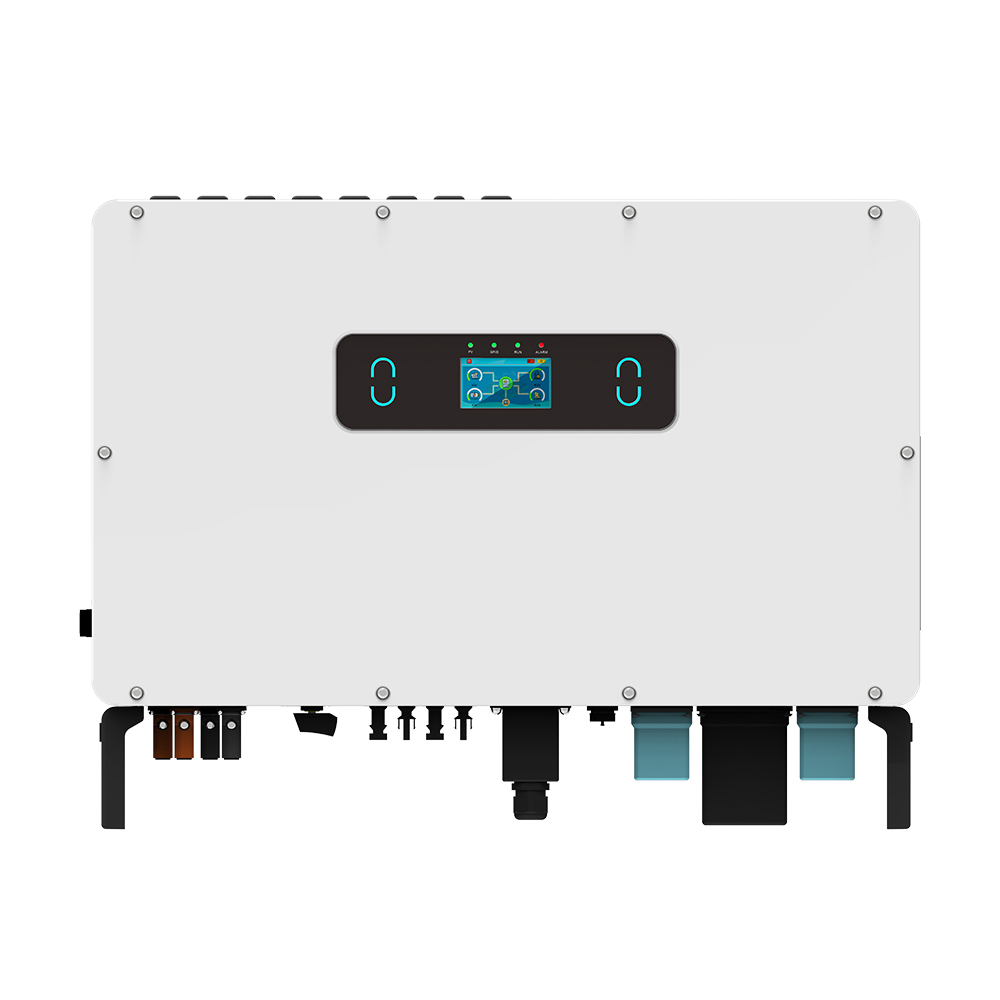
The SUNOHOO HB3299EH800~HB3635EH800 hybrid inverter. Image: SUNOHOO product page (company-owned).
| Model | Max PV input | Rated grid power | Max apparent power | Rated output current (380 / 400 V) | MPPT full-load range |
|---|---|---|---|---|---|
| HB3299EH800 | 60 kW | 29.9 kW | 32.89 kVA | 45.3 / 43.3 A | 250~850 Vdc |
| HB3360EH800 | 72 kW | 36 kW | 39.6 kVA | 54.4 / 52 A | 360~850 Vdc |
| HB3408EH800 | 81.6 kW | 40.8 kW | 44.9 kVA | 61.6 / 58.9 A | 420~850 Vdc |
| HB3510EH800 | 102 kW | 51 kW | 56.1 kVA | 76.9 / 73.6 A | 420~850 Vdc |
| HB3635EH800 | 127 kW | 63.5 kW | 63.5 kVA | 95.9 / 91.7 A | 150~850 Vdc |
Source: SUNOHOO product page for HB3299EH800~HB3635EH800. The HB3635EH800 full-load range is shown as 150~850 Vdc on the source page; confirm this against the PDF datasheet during design.
| Parameter | Value | Why it matters |
|---|---|---|
| Max PV input voltage | 1000 Vdc | Upper limit for cold-weather string voltage |
| PV startup voltage | 180 Vdc | Determines early-morning start |
| Battery voltage range | 150~800 V | Defines compatible battery pack configurations |
| Max charge / discharge current | 70A+70A | Limits how fast the battery can fill or empty |
| Max PV conversion efficiency | 98% | Best-case figure; typical operation is lower |
| European efficiency | 97.6% | Weighted across load levels; more realistic |
| MPPT efficiency | 98.6% | How well it tracks the maximum power point |
| Off-grid overload capability | <110% continuous; 110–120% for 1 min; >120% for 10 s | Motor start-up and surge tolerance |
| Standby consumption at night | 25 W | Small but constant: about 0.6 kWh per 24 hours |
| Protection rating | IP66 | Suitable for outdoor wall mounting |
| Operating temperature | -40°C to 60°C (derates above 45°C) | Plan ventilation and shading |
| Size / weight (HB3299EH800) | 850 × 300 × 535 mm / 62 kg gross | Wall must be rated for the load; plan for two-person handling |
| Warranty | 5 years standard; 10 years optional | Compare terms and claim conditions in writing |
Source: SUNOHOO datasheet. The 25 W standby figure is converted by the author to roughly 0.6 kWh per day (25 W × 24 h). Dimensions and weight are listed on the source page for the first model; confirm figures for larger models in the PDF.
Features that solve specific field problems
- Soft start on battery switch-on. Closing a battery breaker onto a large inverter can create an inrush current that stresses contacts and cells. The manufacturer states the unit eliminates this starting inrush current, which protects both the machine and the battery.
- Parallel operation up to 15 units. Capacity can grow in steps as load grows. For a site that expects expansion, this avoids replacing a unit that was sized too tightly. Check with the manufacturer how mixed models and firmware versions are handled in a parallel group.
- Multi-functional generator interface. A dedicated port enables intelligent switching and control, which the manufacturer says saves additional equipment cost. This is valuable where the grid is unreliable and a diesel set already exists.
- AC coupling for retrofits. Both the AC input port and the generator interface can connect to an existing PV grid-connected inverter. That means a site with an installed solar system can add storage and backup without scrapping the original inverter.
- Time-of-use scheduling. Charging and discharging periods can be set to follow electricity price bands, so the battery charges when energy is cheap and discharges when it is expensive. The 4.3-inch, 65K-color touch screen supports customizable languages.
- Optional arc-fault protection. Integrated AFCI (DC arc fault protection) is listed as an option. Where local codes or insurers require it, specify it at order time rather than discovering the gap at inspection.
A Worked Sizing Example
The following scenario is illustrative, not a design recommendation. Real projects need a site survey and load profile.
Imagine a small workshop with a daytime average load of about 25 kW and a peak of about 35 kW. The owner wants to cut daytime grid purchases and keep critical machines running through short outages.
- Choose AC capacity. A 29.9 kW rated unit (HB3299EH800) covers the average load, and the 32.89 kVA apparent power limit gives some headroom. If peaks regularly exceed that, the series' parallel capability or a larger model is the better path.
- Choose PV capacity. The maximum input is 60 kW. A designer might install somewhere between 40 and 55 kWp, depending on roof area, local irradiance and how much clipping the owner will tolerate. Staying below the maximum leaves margin for string-voltage variation.
- Check string voltage. If a panel has an open-circuit voltage of 50 V at 25°C and a temperature coefficient of about -0.27%/°C, then at -10°C the voltage rises by roughly 35 × 0.27% ≈ 9.5%, giving about 54.7 V. A 16-panel string would reach about 875 V, which is under the 1000 V maximum. At the hot end, voltage must stay above the full-load floor (250 V for this model) even on a very hot day. These panel values are placeholders; use your own datasheet.
- Size the battery. Decide the backup duration for critical loads. Ten critical kilowatts for two hours needs 20 kWh of usable energy, plus margin for depth-of-discharge limits and aging. Verify the battery's voltage falls inside 150~800 V and that its current rating suits the 70A+70A limits.
- Review protection and communications. Confirm the grid code, the need for AFCI, and the monitoring route (RS485, CAN and DRM are standard; 4G, WiFi, GPRS and a temperature compensation module are optional).
Reading Efficiency Claims Critically
A 98% maximum efficiency figure is a peak, measured under controlled conditions at a favorable load point. Three points keep expectations realistic:
- European efficiency (97.6% here) weights performance across several load levels, so it is a better guide to annual yield than the peak.
- Battery round-trip losses sit on top of inverter losses. The listed maximum battery charging/discharging efficiency is 97.6% for the converter stage, but the battery itself adds its own internal losses.
- Standby draw of 25 W at night adds up to a small but permanent loss.
Standards and Certifications: What to Verify
The datasheet lists compliance with IEC 62109-1 and IEC 62109-2, the international safety standards for power converters used in photovoltaic systems, along with EN/IEC 50549-10 and VDE-4105 for grid connection, several EMC standards (EN/IEC 61000 series), and RoHS. These listings tell you what the manufacturer declares. They do not replace a check of the actual certificates.
Before purchase, ask for the certificate documents for the exact model you plan to buy, and confirm that the grid code accepted by your local utility is covered. Requirements differ by country, and a certificate for one market may not satisfy another. For a broader view of the manufacturer's approach, see the certification section on the SUNOHOO About page and the technology page.
Honest Limitations to Consider
- High-voltage battery systems need qualified installers. With battery voltages up to 800 V and PV up to 1000 V, this is not a do-it-yourself product.
- Weight. At 62 kg gross for the HB3299EH800, wall mounting needs a suitable structure and safe lifting procedures.
- Heat derating above 45°C can reduce output in hot climates unless the installation is shaded and ventilated.
- A hybrid is not always the cheapest answer. If your grid is reliable and tariffs are flat, a plain grid-tie inverter may give a faster payback. A hybrid earns its cost where outages, peak tariffs or generator use are real problems.
Frequently Asked Questions
Can a hybrid inverter work without a battery?
Many models can operate as grid-tie inverters without a battery, which lets you add storage later. Confirm this behavior and any firmware settings for your chosen model with the supplier.
Can I connect an existing solar system to it?
For the HB3299EH800 series, the manufacturer states that both the AC input port and the generator interface can connect to a PV grid-connected inverter, which supports retrofitting an existing array with storage.
How many units can run in parallel?
Up to 15 machines, according to the manufacturer. That allows capacity to grow as the site's load grows.
Is it suitable for outdoor installation?
The IP66 rating permits outdoor mounting. Avoid direct, unventilated sun exposure, because the unit derates above 45°C ambient.
What warranty is offered?
The datasheet lists 5 years as standard and 10 years as optional. Ask for the written warranty terms, including exclusions and the claims process, before signing.


